
Music
Overview
Purpose of study
Music is a universal language that embodies one of the highest forms of creativity. A high-quality music education should engage and inspire pupils to develop a love of music and their talent as musicians, and so increase their self-confidence, creativity and sense of achievement. As pupils progress, they should develop a critical engagement with music, allowing them to compose, and to listen with discrimination to the best in the musical canon.
Aims
The national curriculum for music aims to ensure that all pupils:
- perform, listen to, review and evaluate music across a range of historical periods, genres, styles and traditions, including the works of the great composers and musicians
- learn to sing and to use their voices, to create and compose music on their own and with others, have the opportunity to learn a musical instrument, use technology appropriately and have the opportunity to progress to the next level of musical excellence
- understand and explore how music is created, produced and communicated, including through the inter-related dimensions: pitch, duration, dynamics, tempo, timbre, texture, structure and appropriate musical notations.
Attainment targets
By the end of each key stage, pupils are expected to know, apply and understand the matters, skills and processes specified in the relevant programme of study.
Subject content
Key stage 1
Pupils should be taught to:
- use their voices expressively and creatively by singing songs and speaking chants and rhymes
- play tuned and untuned instruments musically
- listen with concentration and understanding to a range of high-quality live and recorded music
- experiment with, create, select and combine sounds using the inter-related dimensions of music.
Key stage 2
Pupils should be taught to sing and play musically with increasing confidence and control. They should develop an understanding of musical composition, organising and manipulating ideas within musical structures and reproducing sounds from aural memory.
Pupils should be taught to:
- play and perform in solo and ensemble contexts, using their voices and playing musical instruments with increasing accuracy, fluency, control and expression
- improvise and compose music for a range of purposes using the inter-related dimensions of music
- listen with attention to detail and recall sounds with increasing aural memory
- use and understand staff and other musical notations
- appreciate and understand a wide range of high-quality live and recorded music drawn from different traditions and from great composers and musicians
- develop an understanding of the history of music.
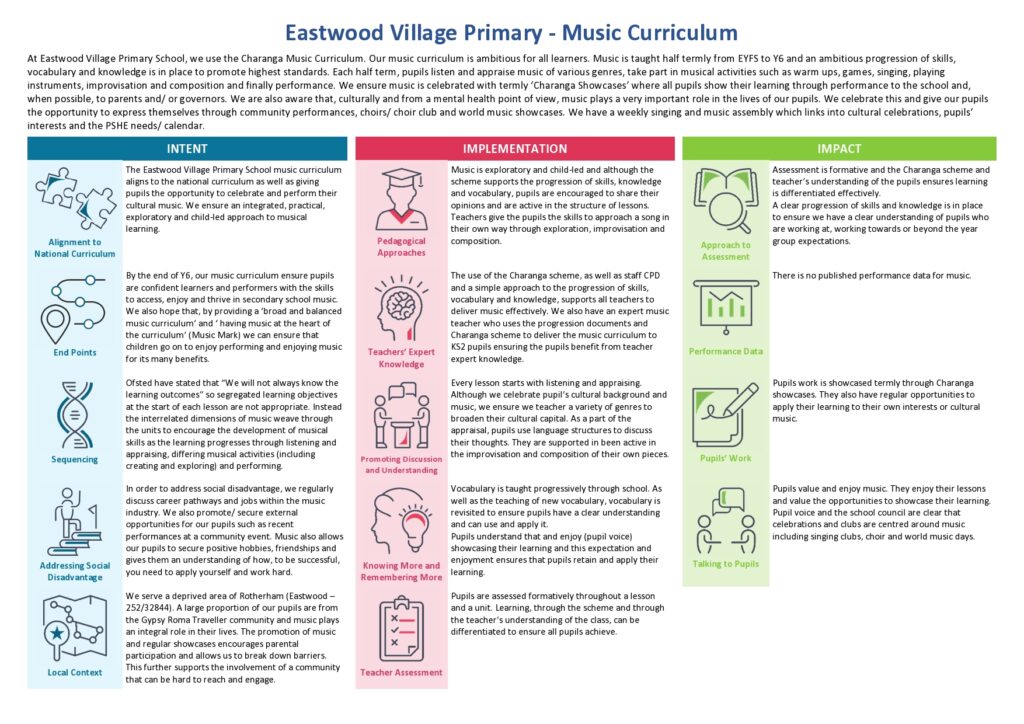
Intent, Implementation, Impact
Progression of Language
Progression of Skills
| Song and Style | Instrument | Vocabulary to be introduced or recapped | Key Knowledge | Key Skills | |
| FS | Autumn Term Me! | Percussion | Pulse | o To sing or rap nursery rhymes and simple songs from memory.o Songs have sections.o A performance is sharing music.o To know that we can move with the pulse of the music. | o To sing along with a pre-recorded song and add actions.o To sing along with the backing track.o Perform any nursery rhymes or songs adding a simple instrumental part |
| Spring Term Everyone! | Percussion | Pulse | |||
| Summer Term Big Bear Funk | Percussion/Glockenspiels | Pulse | |||
| Year 1 | Autumn Term Hey You! Old School Hip Hop | Percussion/Glockenspiels | Pulse | o To confidently sing or rap songs from memory and sing them in unison.o Learn the names of the notes in their instrumental part from memory or when written down.o Learn the names of the instruments they are playing | o Learn about voices, singing notes of different pitches (high and low). Learn that they can make different types of sounds with their voices – you can rap or say words in rhythm.o Learn to start and stop singing when following a leader.o Treat instruments carefully and with respect.o Listen to and follow musical instructions from a leader.o Play a tuned instrumental part with the song they perform |
| Spring Term Round and Round Bossa Nova | Percussion/Glockenspiels | Rhythm Pulse | |||
| Summer Term Your Imagination Pop | Percussion/Glockenspiels | Pitch Rhythm | |||
| Year 2 | Autumn Term Hands, Feet, Heart Afropop (South African) | Percussion/Glockenspiels | Pulse Rhythm Pitch | o To confidently know and sing five songs from memory.o To know that unison is everyone singing at the same time.o Songs include other ways of using the voice e.g. rapping (spoken word).o Learn the names of the notes in their instrumental part from memory or when written down.o Know the names of untuned percussion instruments played in class. | o Learn about voices singing notes of different pitches (high and low).o Learn that they can make different types of sounds with their voices – you can rap (spoken word with rhythm).o Learn to find a comfortable singing position.o Learn to start and stop singing when following a leader.o Play the part in time with the steady pulse.o Listen to and follow musical instructions from a leader. |
| Spring Term I wanna play in a band Rock | Percussion/Glockenspiels | Dynamics Tempo | |||
| Summer Term Friendship Song Pop | Percussion/Glockenspiels | Dynamics Tempo | |||
| Year 3 | Autumn Term Let Your Spirit Fly RnB | Glockenspiels | Structure Pulse Rhythm Pitch | o Singing in a group can be called a choiro Leader or conductor: A person who the choir or group follow Songs can make you feel different things e.g. happy, energetic or sad Singing as part of an ensemble or large group is fun, but that you must listen to each othero To know and be able to talk about the instruments used in class (a glockenspiel, a recorder) | o To sing in unison and in simple two-parts.o To follow a leader when singing.o To sing with awareness of being ‘in tune’o To have an awareness of the pulse internally when singingo To rehearse and perform their part within the context of the Unit song.o To listen to and follow musical instructions from a leader |
| Spring Term Three Little Birds Reggae | Recorders | Dynamics Tempo | |||
| Summer Term Bringing Us Together Disco | Glockenspiels | Texture Structure | |||
| Year 4 | Autumn Term Mamma Mia Pop | Recorders | Dynamics Tempo | o Texture: How a solo singer makes a thinner texture than a large groupo To know why you must warm up your voiceo To know and be able to talk about the instruments used in class (a glockenspiel, recorder and other instruments they might play or be played in a band or orchestra or by their friends. | o To sing with awareness of being ‘in tune’.o To rejoin the song if lost.o To listen to and follow musical instructions from a leader.o To experience leading the playing by making sure everyone plays in the playing section of the song |
| Spring Term Stop! Grime | Glockenspiels | Texture Structure | |||
| Summer Term Lean On Me Gospel | Glockenspiels | Notation | |||
| Year 5 | Autumn Term Livin’ On a Prayer Rock | Glockenspiels | Timbre Structure | o To choose a song and be able to talk about: Its main features, singing in unison, the solo, lead vocal, backing vocals or rapping and to know what the song is about and the meaning of the lyricso To know and be able to talk about different ways of writing music down – e.g. staff notation, symbols | o To sing in unison and to sing backing vocalso To experience rapping and solo singing.o To listen to each other and be aware of how you fit into the group.o To sing with awareness of being ‘in tune’. |
| Spring Term The Fresh Prince of Bel-Air Old School Hip Hop | Glockenspiels | Notation | |||
| Summer Term Dancing in the Street Motown | Recorders | Notation Timbre | |||
| Year 6 | Autumn Term Happy Pop/ Neo Soul | Recorders | Notation Texture | o To know about the style of the songs so you can represent the feeling and context to your audienceo To choose a song and be able to talk about: Its main features, singing in unison, the solo, lead vocal, backing vocals or rapping and to know what the song is about and the meaning of the lyricso To know and be able to talk about different ways of writing music down – e.g. staff notation, symbols | o To sing in unison and to sing backing vocalso To experience rapping and solo singing.o To listen to each other and be aware of how you fit into the group.o To sing with awareness of being ‘in tune’.o To lead a rehearsal session |
| Spring Term You’ve Got a Friend 70s Ballad/ Pop | Glockenspiels | Melody Harmony Structure | |||
| Summer Term Music and Me Cultural Music and their own inspirations/ identities | Linked to pupils interest or cultural music | Improvise Compose Structure |